
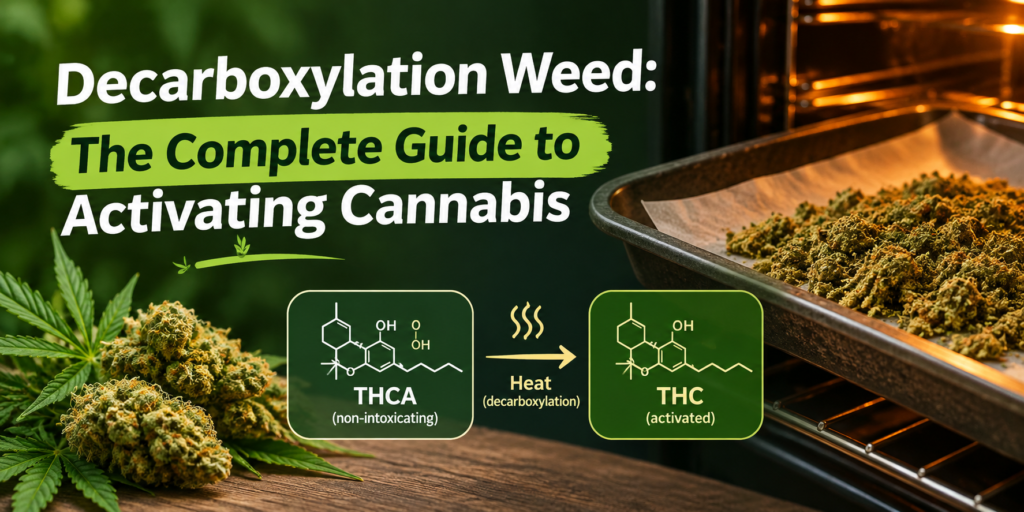
If you’ve ever looked into making cannabis edibles or wondered why people heat cannabis before using it in certain recipes, you’ve probably come across the term decarboxylation.
It sounds complicated, but the science behind it is fairly straightforward.
Raw cannabis contains naturally occurring compounds that behave differently once exposed to heat. Decarboxylation is the chemical process responsible for some of those changes, and understanding it can help explain why raw cannabis, smoked flower, and cannabis-infused foods produce different experiences.
In this guide, we’ll explore what cannabis decarboxylation means, how it works, which cannabinoids are affected, and why temperature and storage conditions matter.
What Is Cannabis Decarboxylation?
Decarboxylation, often shortened to “decarbing,” is a chemical reaction that removes a carboxyl group from certain molecules, releasing carbon dioxide in the process.
In cannabis, this reaction is particularly important because many cannabinoids naturally occur in their acidic forms.
For example, freshly harvested cannabis typically contains tetrahydrocannabinolic acid (THCA) rather than large amounts of delta-9-tetrahydrocannabinol (THC).
When THCA undergoes decarboxylation, it converts into THC, the cannabinoid primarily associated with the intoxicating effects of cannabis.
A similar process occurs with cannabidiolic acid (CBDA), which converts into cannabidiol (CBD).
This transformation helps explain why eating fresh, unheated cannabis flower generally produces a different experience from consuming a product containing activated THC.
Why Does Cannabis Need to Be Decarboxylated?
The answer depends on how cannabis is being used.
For products intended to contain active THC, decarboxylation is an important part of the chemistry. Without sufficient conversion, much of the original THCA may remain unchanged.
That doesn’t mean raw cannabis is useless or that every cannabinoid must be activated to have biological activity.
THCA and CBDA are being studied for their own properties, although research into their potential therapeutic applications remains limited.
Decarboxylation is especially relevant when discussing cannabis extracts, infused oils, and edibles because the cannabinoid composition of the final product can affect its potency and overall effects.
The Science Behind THCA and THC
Although THCA and THC are closely related, their molecular structures are different.
THCA contains an additional carboxyl group. When sufficient energy is introduced, this group can be removed, producing THC and carbon dioxide.
The basic reaction can be summarized as:
THCA → THC + CO₂
The same general principle applies to several other acidic cannabinoids.
However, conversion isn’t always complete. Depending on processing and storage conditions, cannabis products may contain a mixture of acidic and neutral cannabinoids.
THC can also degrade through other chemical reactions, meaning that more heat or longer exposure does not necessarily produce a stronger final product.
How Temperature Affects Decarboxylation
Temperature is one of the most important factors influencing cannabinoid conversion.
Higher temperatures generally accelerate chemical reactions, including decarboxylation. However, excessive heat can also contribute to cannabinoid degradation and changes in the plant’s aromatic compounds.
Cannabis contains terpenes, which contribute to its distinctive smell and flavour. Some terpenes are volatile and can be lost during heating or processing.
This creates a balance between cannabinoid conversion and preservation of other plant compounds.
There is no single universal temperature or processing duration that guarantees identical results for every cannabis sample. Moisture, plant composition, equipment, and environmental conditions can all influence the outcome.
Commercial producers may use controlled processing methods and laboratory testing to assess cannabinoid content rather than relying on appearance or aroma alone.
Decarboxylation vs. Smoking or Vaping Cannabis
One common question is why cannabis needs to undergo decarboxylation for some products when people can simply smoke or vape flower.
The difference is how heat is introduced.
When cannabis is smoked, high temperatures rapidly cause chemical changes, including decarboxylation. Vaporization can also convert some acidic cannabinoids as the material is heated.
Cannabis-infused foods are different because the preparation and consumption processes may not provide the same direct heating conditions.
This is one reason why the chemical composition of cannabis edibles can differ from that of raw flower.
It’s also worth remembering that smoking exposes users to combustion products, while vaping has its own respiratory risks. Neither method is risk-free.
Does Decarboxylation Change Cannabis Potency?
Yes, but the relationship is more complicated than simply heating cannabis to make it stronger.
Decarboxylation changes the proportion of acidic and neutral cannabinoids present in a sample.
As THCA converts into THC, the amount of potentially intoxicating THC can increase.
However, the final potency depends on several factors, including the original cannabinoid content, conversion efficiency, degradation, and product consistency.
Laboratories often report both THC and THCA concentrations. Some labels also include a calculated total potential THC value.
Understanding these distinctions can help consumers interpret cannabis product labels more accurately.
Does Decarboxylation Affect Terpenes?
Cannabis is known for its wide variety of aromas, from earthy and pine-like scents to citrus, floral, and sweet notes.
Many of these characteristics come from terpenes.
Because some terpenes are sensitive to heat and evaporation, processing conditions can influence the final aroma profile.
For example, a cannabis flower with a strong citrus scent may smell noticeably different after prolonged heat exposure.
This doesn’t automatically mean the cannabinoids have disappeared. It simply reflects the fact that cannabinoids and terpenes have different chemical properties.
The relationship between terpenes and cannabis effects remains an active area of research, and claims about specific terpene combinations should be approached carefully.
Common Misunderstandings About Cannabis Decarboxylation
Myth 1: Raw cannabis contains no THC.
Raw cannabis can contain some THC, although THCA is often the predominant form in freshly harvested flower.
Myth 2: More heat always means greater potency.
Excessive heat can lead to chemical degradation. Cannabinoid conversion and cannabinoid preservation are not the same thing.
Myth 3: Decarboxylation makes every cannabis product identical.
Different strains, extracts, and finished products can have substantially different cannabinoid and terpene profiles.
Myth 4: You can accurately judge THC content by smell or colour.
Neither smell nor colour provides a reliable measurement of THC concentration. Laboratory testing is the more dependable method.
Cannabis Decarboxylation and Edibles
Decarboxylation is frequently discussed in connection with cannabis edibles, including gummies, chocolates, and infused foods.
Unlike inhaled cannabis, edible THC is absorbed through the digestive system and metabolized by the liver. Part of it is converted into 11-hydroxy-THC, an active metabolite that contributes to the effects of orally consumed THC.
Edibles generally take longer to produce noticeable effects than inhaled cannabis, and those effects can last considerably longer.
This delayed onset is one reason accidental overconsumption can occur.
Consumers should choose clearly labelled, regulated products, follow the stated serving information, and avoid taking additional THC simply because the effects have not appeared immediately.
Cannabis edibles should always be stored securely away from children and pets.
How Storage Conditions Influence Cannabis
Heat isn’t the only factor that affects cannabinoid chemistry.
Light, oxygen, humidity, and storage duration can all contribute to changes in cannabis products.
Over time, cannabinoid concentrations and terpene profiles may shift, particularly when products are exposed to unsuitable environmental conditions.
Properly sealed packaging and storage away from excessive heat and direct sunlight can help maintain product quality.
However, storage alone cannot guarantee that a product will retain its original chemical composition indefinitely.
Frequently Asked Questions
What does decarboxylation mean in cannabis?
Decarboxylation is a chemical reaction that converts acidic cannabinoids, such as THCA and CBDA, into their neutral forms, THC and CBD, by removing a carboxyl group.
Can cannabis decarboxylate naturally?
Yes. Slow chemical changes can occur during drying, curing, and storage. However, the rate of conversion varies considerably with environmental conditions.
Is THCA the same as THC?
No. THCA and THC are chemically related but have different properties. THCA does not produce the same characteristic intoxicating effects as delta-9-THC.
Does decarboxylation destroy CBD?
Decarboxylation converts CBDA into CBD. However, CBD can also degrade under certain processing conditions, particularly with excessive heat exposure.
Is decarboxylation necessary for every cannabis product?
No. Its relevance depends on the intended cannabinoid composition and product type. Some products intentionally contain acidic cannabinoids.
Can you tell whether cannabis has been fully decarboxylated?
Appearance and smell cannot reliably confirm complete conversion. Laboratory cannabinoid analysis is the most accurate way to determine the relative amounts of THCA and THC.
Bottom Line
Learning about the heating process before making homemade cannabis products can save time, improve consistency, and help you achieve better results. A little patience and the right approach can make every recipe more enjoyable. From infused butter to cooking oils and baked treats, proper preparation allows your cannabis to perform as expected.
At Puff Pass, we believe quality cannabis deserves quality preparation. We offer carefully selected products that help you create dependable homemade infusions with confidence. Whether you are trying homemade edibles for the first time or improving your favorite recipes, Puff Pass is ready to provide premium cannabis products and trusted service for your next experience.
